
GM from the Netherlands
GM from the Netherlands. A country known for tulips, canals, and one of the most digitally advanced economies in Europe. It is also Thrilld Labs’ home base. That begs the question: how exactly is the Netherlands approaching crypto and Web3 in 2026? From adoption to regulatory efforts, market participants, taxation, the ecosystem’s events as well as challenges… continue reading to know how crypto really works in the Netherlands.
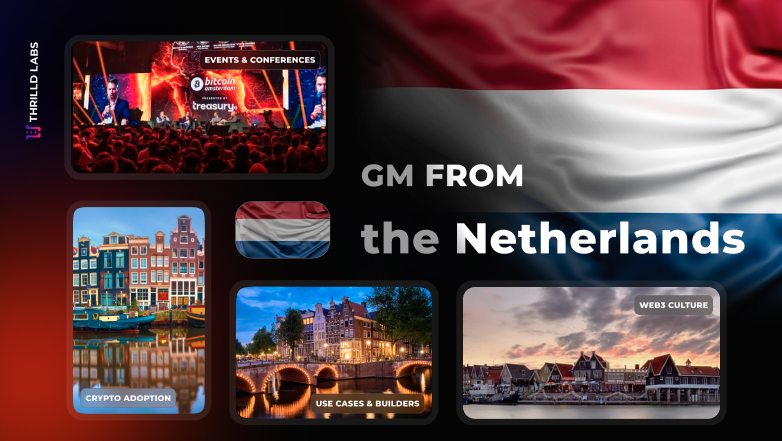
At Thrilld Labs, our team has included people from all around the world, coming from countries such as the Netherlands and Italy, to the United States, South Korea, Nigeria, Russia, and China too. Fundamentally, we argue that global collaboration is a big part of what Web3 intends: creating an ecosystem that removes traditional barriers to participation thanks to its inherent construction around a decentralised network. However, even with these decentralised beginnings, there remain challenges for everyone to have the same opportunities.
Whether it be from the lack of an internet connection or laptop, a wide knowledge gap, or legal limitations, your location and personal situation are (fortunately or unfortunately) determining factors even in Web3. And, where you live and who you are surrounded by do influence your work environment and how easily you can enter or do business in the Web3 space, or any, for that matter! (Find here our related article: Networking Theories: Human Connectivity in Web3).
At the same time, we see the global nature of Web3 coming to the surface in global teams (such as our own :)), in the increasing number of international Web3 companies, and, last but not least, in all the Web3 events taking place globally.
As a global Web3 company, and one that actively works with international events, communities, and partners, we are very curious to know more about the blockchain ecosystem and emerging crypto spaces in different countries. As well as how professionals and individuals are contributing to discussions and furthering global participation by breaking down entry barriers.
To this end, we’ve created the GM From series, where previous editions have looked at how the crypto industry is developing in countries including India, Sweden, Kazakhstan, Kyrgyzstan, Nigeria, and Morocco, what adoption looks like, and what we can expect looking ahead. This time, we’ll be turning to our home country, the Netherlands.
We ask: what exactly does the crypto industry in the Netherlands look like? What are regulations like? And what unique challenges or opportunities may the Netherlands' Web3 ecosystem face?
To aid in our research, we spoke with Mathijs Kriek, a trading and investment professional with over 25 years of experience in financial markets. He is currently the Blockchain Technology Strategy Portfolio Manager at TreeCap as well as the Owner of M2tK Consultancy. Since 2017, Mathijs has been actively involved in trading, investing, and conducting research in digital assets. He also runs a popular weekly newsletter covering the markets of digital assets.
Speaking with Mathijs and consulting other research sources and data points, read below our most recent GM From article on the crypto space in the Netherlands.
Crypto in the Netherlands
With a partially Dutch team, we know that the Netherlands certainly occupies a unique position among developed economies, i.e., a highly digitised, near cashless society where digital payments are the norm and fintech innovations are widely adopted and further on the rise. In such an environment, crypto doesn’t necessarily always emerge as a solution to financial exclusion; rather, it has to prove its value beyond conveniences per se, and is often seen as an investment asset or technological application.
Indeed, crypto adoption and use in the Netherlands stands at an advanced stage; however, everyday usage as a medium of exchange continues to remain limited. Adoption is seen as mostly driven by investment interest rather than payments or commercial usage, which is similar to many other mature markets in developed economies.
Mathijs Kriek (a Dutch crypto professional with over 25 years of experience in financial markets), told us that crypto assets in the Netherlands remain sometimes misunderstood beyond Bitcoin and Ethereum. As he explained, “digital tokens are primarily seen as speculative assets for retail investors,” even though the underlying ecosystem has expanded far beyond this perception.
Crypto Adoption and Usage
Crypto adoption in the Netherlands has grown significantly over the last few years. As of 2023, the number of crypto owners in the Netherlands stood at 2 million which is approximately 11% of the total population. On average, Dutch crypto holders have also invested close to 11% of their disposable income in cryptocurrencies.
This level of ownership places the Netherlands among one of the most engaged crypto markets in Europe in terms of awareness and participation.
Yet, the primary use case remains financial investment rather than everyday transactions. Whilst we may expect that an additional number of people use crypto on-chain or hold assets in self-custodial wallets, activities such as retail payments using crypto appear still very limited as most Dutch are pretty comfortable with their highly efficient digital payment systems.
Mathijs further reinforced these distinctions, explaining that while crypto payments remain niche, blockchain adoption itself has advanced far more. He explained, “In contrast to crypto as a payment method, the Netherlands is a strong hub for blockchain applications beyond payments,” particularly in areas like supply chain transparency, digital identity, asset tokenisation, and enterprise use cases.
This trend is similar to the patterns observed in other advanced economies, where cryptocurrency is viewed as a store of value or a speculative asset, rather than a substitute for contactless cards or mobile IBAN payments (see, for instance, our article GM from Sweden).
Now what about mining, you wonder? High environmental standards, a highly imperfect energy supply grid, and aggressive carbon reduction goals make PoW-based systems generally (there are wonderful exceptions where energy is being sustainably used for or of miners) less attractive to run in the Netherlands. Institutional and public support for energy-intensive application therefore, remains cautious.
A Regulatory Framework: Background and Recent Developments
Cryptocurrencies in the Netherlands are legal, but the regulatory environment can be characterised as strict, with strong compliance requirements rather than permissive. At its core, crypto service providers must adhere to the Anti-Money Laundering and Counter-Terrorist Financing Act (Wwft) and register with De Nederlandsche Bank (DNB) to operate legally.
Since 2020, registration is mandatory for exchanges and custodians operating in or from the Netherlands. This rule is strictly enforced, and as a matter of fact, Dutch regulators have fined multiple international players for failing to comply, including Crypto.com and Bybit.
With the rollout of the EU’s Markets in Crypto-Assets Regulations (MiCA), the regulatory landscape has been modernised even further. MiCA basically creates a uniform crypto regulation across all EU member states and came fully into force for Crypto-Asset Services Providers (CASPs) on 30th December, 2024. This means that the service providers now need a MiCA license issued by the Dutch Authority for the Financial Markets (AFM) (or another European regulator) in order to operate legally across the block. This has not necessarily weakened Dutch enforcement, rather, this transition to MiCA has upheld the strict compliance requirements while also providing clearer legal certainty and more consumer safeguards. Dutch-licensed crypto firms can now passport across all 27 member states.
Yet, regulatory clarity at the policy level doesn't automatically translate into operational access. Dutch banks remain highly risk-averse towards crypto and Web3-related businesses, and as a result, even fully compliant MiCA-ready startups can struggle to open or maintain basic bank accounts. On the other hand, Mathijs pointed out how regulations have become a decisive factor in shaping the market’s direction; “Regulations are the key to attracting institutional investors.” Mathijs also mentioned that regulations arguably tend to disproportionately affect early-stage start-ups, something we agree with, whilst larger well-capitalised players are better positioned to absorb compliance costs, all-in-all contributing to gradual market conciliation.
Indeed, regulatory clarity at the policy level doesn't automatically translate into operational access. At Thrilld Labs, we know by experience (and heard from many others in our network) that Dutch banks remain pretty risk-averse towards crypto and Web3-related businesses, and as a result, many startups can struggle to open basic bank accounts, which arguably underlines crypto's raison d'être once more.
Market Size, Ecosystem and Economic Impact
The Dutch crypto market continues to grow alongside broader blockchain and digital finance innovation trends. Forecasts estimate that the sector could expand from around $26.2 billion in 2024 to roughly $60.5 billion by 2033, at a CAGR of nearly 9.8% between 2025 and 2033.
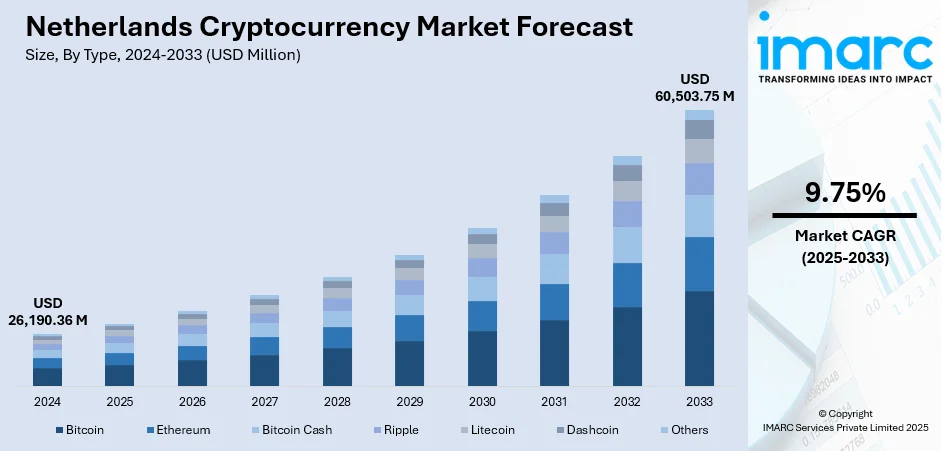
Additionally, crypto-related activities such as exchange trading, custody services, tooling, and infrastructure generated $950-970 million in revenue in 2025 alone. It is expected to rise by approximately 3.07% in 2026, bringing total market revenue to around $996.3 million. These noteworthy data points are underpinned by the country’s high digital literacy and expanding investor base as noted above. Though these numbers are forecasts, they also do signal steady growth rooted in infrastructure and professional adoption rather than speculative spikes alone.
Fascinatingly, and shifting towards the short-term, Mathijs observed that recent market dynamics have shifted participation patterns. Retail investors, he noted, are “almost completely out at the moment,” following multiple leverage and liquidity events in 2025, particularly the major liquidation event of 10 October 2025. Institutional interest, by contrast, has increased sharply, driven by curiosity around tokenisation and stablecoins.
Apart from a growing footprint in enterprise and institutional adoption, the Netherlands hosts an active Web3 builders' ecosystem, especially around DeFi infrastructure and tooling, digital identity solutions, and blockchain analytics and compliance.
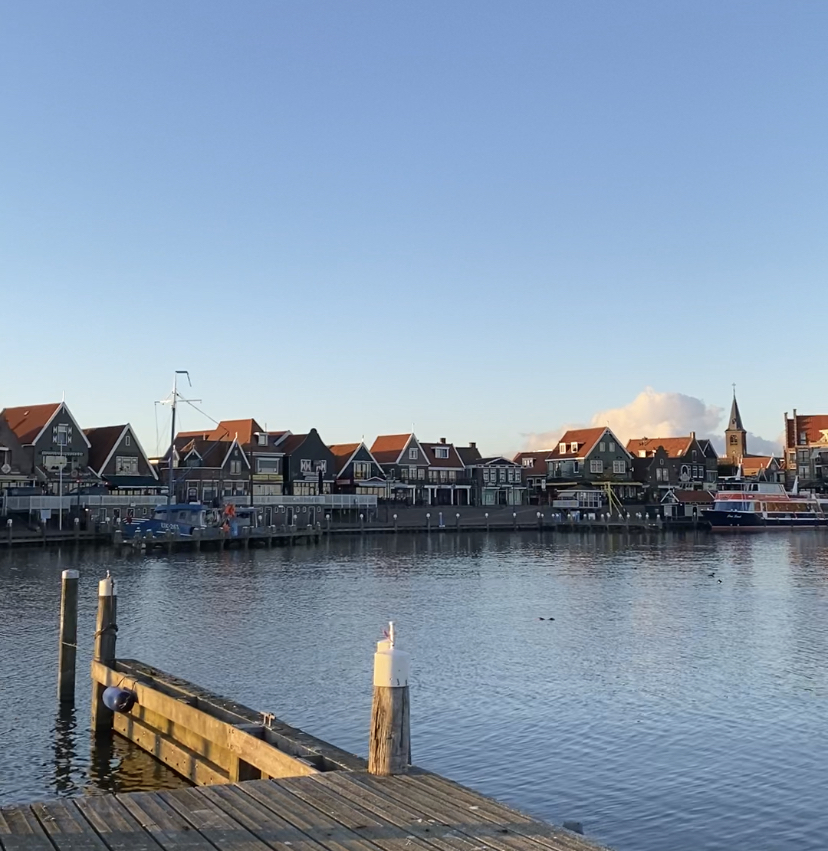
In fact, in Amsterdam alone, Tracxn reports in January 2026 around 141 cryptocurrency startups, including trading platforms and blockchain projects. Nationwide, Tracxn lists approximately 401 crypto-related startups and bigger entities as of mid-2025, many of which are funded.
In addition, the Blockchain Netherlands Foundation (BCNL) has noted to count over 100 members, primarily blockchain, crypto, and Web3 startups and scale-ups.
Besides Amsterdam, major innovation hubs essentially include Rotterdam and Eindhoven, which are anchored by universities, research centers, incubators, and international (Web3) communities.
Moreover, we might well argue that the Netherlands’ role as a global logistics and brain and trade hub also creates opportunities for blockchain-enabled supply chain and trade finance solutions, which can, in the longer-term, become major Web3 adoption drivers outside of investment dynamics.
In terms of public sector engagement, the DNB participates in European Central Bank-led digital euro research, exploring CBDC integration. Naturally there is pan-European dimension to this: the digital euro could be a reality in 2029 at the earliest.
Taxation Complexity
Taxation in the Netherlands is framed around the Box System, with most crypto held in Box 3 (savings & investments) and taxed on a deemed (fictitious return) rather than actual realised gains, a structure that sometimes frustrates long-term holders and passive investors since they pay taxes even if they incur a loss in the value.
If crypto holdings fall under Box 3 and total assets remain below the tax-free allowance, investors basically pay no tax at all. For 2026, this allowance stands at about €60.000 per person.If exceeded, since the Dutch system assumes a fictitious return of approximately 5.88% on crypto assets, which is then taxed at 36%. In practice, this often results in an annual tax burden of 2-3% of the asset value, even if no assets are sold, and ultimately leads to investor dissatisfaction.
The wealth tax, combined with the potential income tax in Box 1 for professional activities, further complicates planning and creates perceived barriers for the more sophisticated market actors. Looking ahead, the Netherlands may likely transition towards taxing actual realised gains from 2028, a move that could increase taxes for profitable investors while reducing the unfair burden during periods of losses.
Events in the Netherlands
And what about events, ultimately the place where people meet, connect, and do business? Dutch Blockchain Week (with the Dutch Blockchain Summit taking place on June 24-25 at the Johan Cruijff ArenA, home of Ajax) will run from June 22-28 2026, with Amsterdam positioning itself as a key global city for digital assets. Impressively, the event convenes more than 40 side events and thousands of professionals, institutions, exchanges, banks, regulators, and others from around the world.
Alongside that, we also much appreciate the yearly Bitcoin Amsterdam, taking place on November 5th to 6th 2026, once again joining thousands of builders, enthusiasts, developers, and industry leaders together.
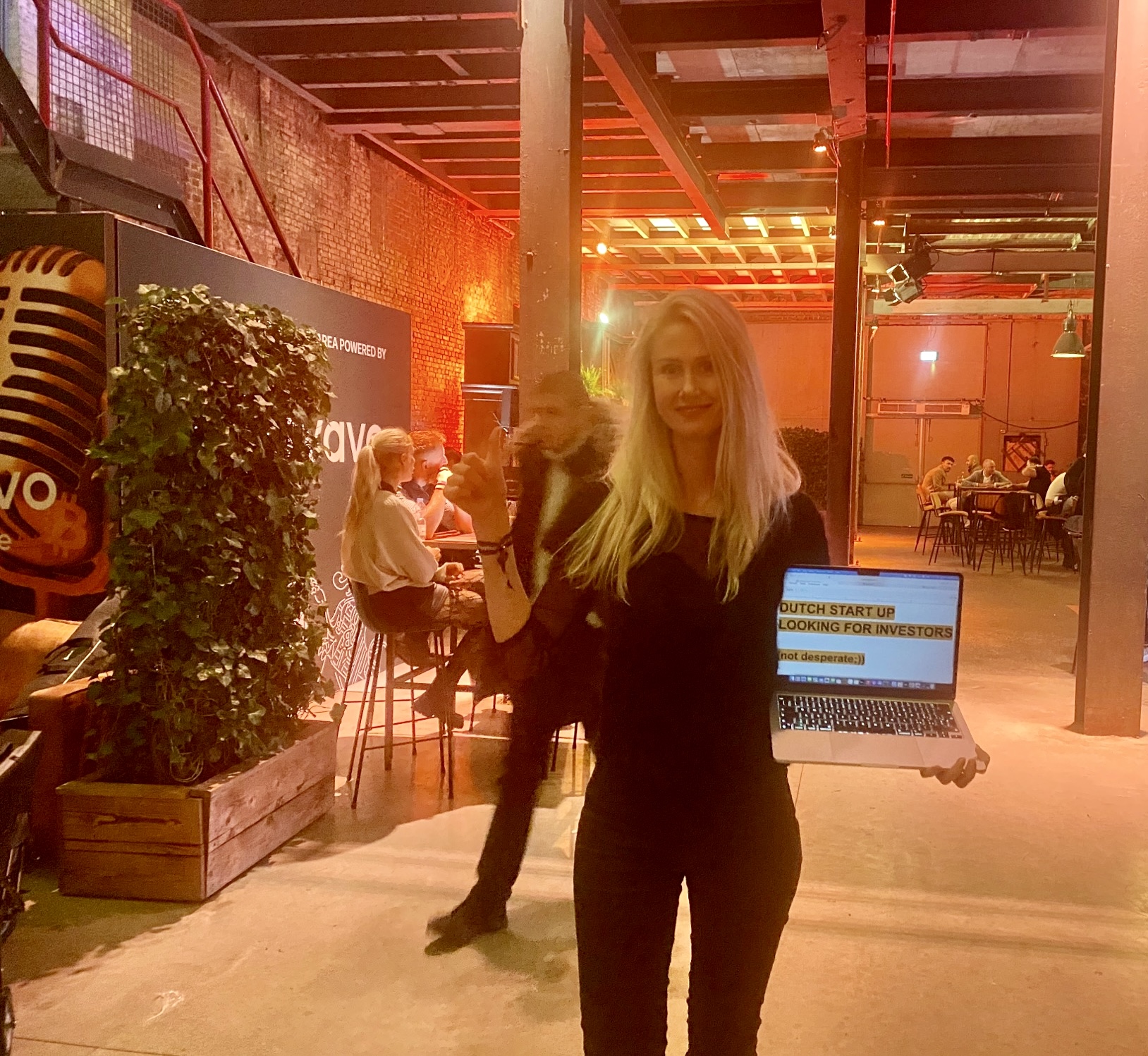
As a Dutch Web3 company, we at Thrilld Labs hope to see both Dutch and international folks in the Netherlands in 2026, whether it will be at one of these two events or at another gathering (whilst event organisers are much welcomed to contact us for collaborations).
Conclusion
The Netherlands’ crypto and Web3 landscape in 2026 reflects a market which is maturing rather than accelerating blindly. While crypto adoption remains largely investment-driven, interest in broader blockchain applications, ranging from tokenisation and digital identity to enterprise and infrastructure use cases, continues to grow. The country is home to a diverse set of Web3 startups and builders, supported by strong digital infrastructure and regulatory clarity under MiCA.
However, at the same time, not all blockchain use cases scale equally. Certain applications remain constrained by broader economic and structural challenges, including energy supply and sustainability goals, as well as a lack of skilled professionals.
While clarity can be an advantage, the Netherlands’ strict enforcement may raise compliance costs that can disproportionately burden smaller startups and early-stage projects. On the other hand, a strict yet predictable regulatory framework has helped attract institutional capital, enterprise clients, and serious Web3 builders. Today, many MiCA-compliant Dutch firms build trust through true business models or work with with banks, enterprises, and public institutions.
Taken together, the digitally native population, strong infrastructure, and regulatory framework continue to make the Netherlands stand out as an interesting and dynamic spot for Web3 development. Both on the ground and in the communities that form around it, we at Thrilld Labs would argue by experience.
The research and data used in this article are up-to-date as of January 2026.
Read more research pieces:
GM from Kyrgyzstan–Thrilld Labs
GM from Kazakhstan–Thrilld Labs
Resources
“Majority of Dutch people willing to use digital euro” (DNB)
“Crypto Regulations in the Netherlands 2025” (Global Investor Code)
“Nigeria Cryptocurrency Regulations” (BTC Lawyer)
“Markets in Crypto-Assets Regulation” (AFM)
“Why might there be a digital euro?” (DNB)
“Crypto Adoption Around the World: Netherlands” (UPay)
“Netherlands Ranks as the Most Crypto-Obsessed Country in the World” (The Defiant)
“Best Crypto Exchanges in the Netherlands” (Datawallet)
