
GM from India
Our BD & Research Associate, Aakansha Yadav (herself from India), found that despite the regulatory uncertainty, crypto is one of the country's most dynamic sectors. Indeed, one of the world’s fastest-growing digital economies, India has much established itself as one of the major players in crypto adoption, Web3 innovation, and blockchain development. We say: GM India! Read on to find out what the space in India looks like...

In the previous edition of “GM From”, we explored how the crypto industry has evolved in countries like Morocco, Kyrgyzstan, Sweden, Nigeria, and Kazakhstan, each highlighting unique factors that shape their national ecosystem. This time, we turn to India–the world’s largest democracy, a powerhouse of young talent, especially in the tech sector, and now a hub in digital assets and blockchain innovation.
At Thrilld Labs, our team has included people from around the world, coming from countries such as the Netherlands and Italy, to South Korea, Russia, the United States, Nigeria, and China, too. Fundamentally, we argue that global collaboration is a big part of what Web3 intends: creating an ecosystem that removes traditional barriers to participation thanks to its inherent construction around a decentralized network. However, even with these decentralized beginnings, there remain challenges for everyone to have the same opportunities.
Whether it be from the lack of an internet connection or laptop, a heavily felt knowledge gap, or legal limitations, your location and personal situation are determining factors in Web3. And, where you live and who you are surrounded by, fortunately or unfortunately, do influence your work environment and how easily you can enter or do business in the Web3 space, or any, for that matter! (Networking Theories: Human Connectivity in Web3, Thrilld Labs).
At the same time, we see the global nature of Web3 coming to the surface in global teams (such as our own :)), in the increasing number of international Web3 companies, and, last but not least, in all the Web3 events taking place globally.
As a global Web3 company and one that actively works with international events, communities, and partners, we are very curious to know more about the Web3 ecosystem and emerging crypto spaces in different countries, as well as how communities and individuals are contributing to discussions and furthering global participation through the breaking down of entry barriers.
Crypto Adoption and Usage in India
India has consistently ranked among the top countries globally in crypto adoption. According to Chainalysis’ 2025 Global Crypto Adoption Index, India holds first place across all key indicators, including centralised and decentralised finance (DeFi) value received, as well as both retail and institutional activity.
Despite a challenging and, to a certain extent, uncertain regulatory climate, crypto ownership continues to expand. Roughly 118.97 million Indians (7.1% of the population) hold cryptocurrency (as of late 2025, CryptoGo), making India one of the largest markets by user count globally. A survey in June 2023 found that the motivations were cited as diversification, access to alternative investments, and curiosity.
Gender and age trends point to growing inclusivity in India’s crypto landscape. While the earlier data did show a strong rise in female participation, more recent patterns continue to portray that women are increasingly claiming financial agency, i.e., they are exploring the Web3 space-related opportunities, taking ownership of investment decisions, and actively engaging more in digital finance.
Demographic data also shows younger investors dominating. A recent Q3 2025 report from Coinswitch indicates that Gen Z (aged 18-25) now makes up 37.6% of crypto investors in India, just ahead of millennials (26-35) at 37.3%.
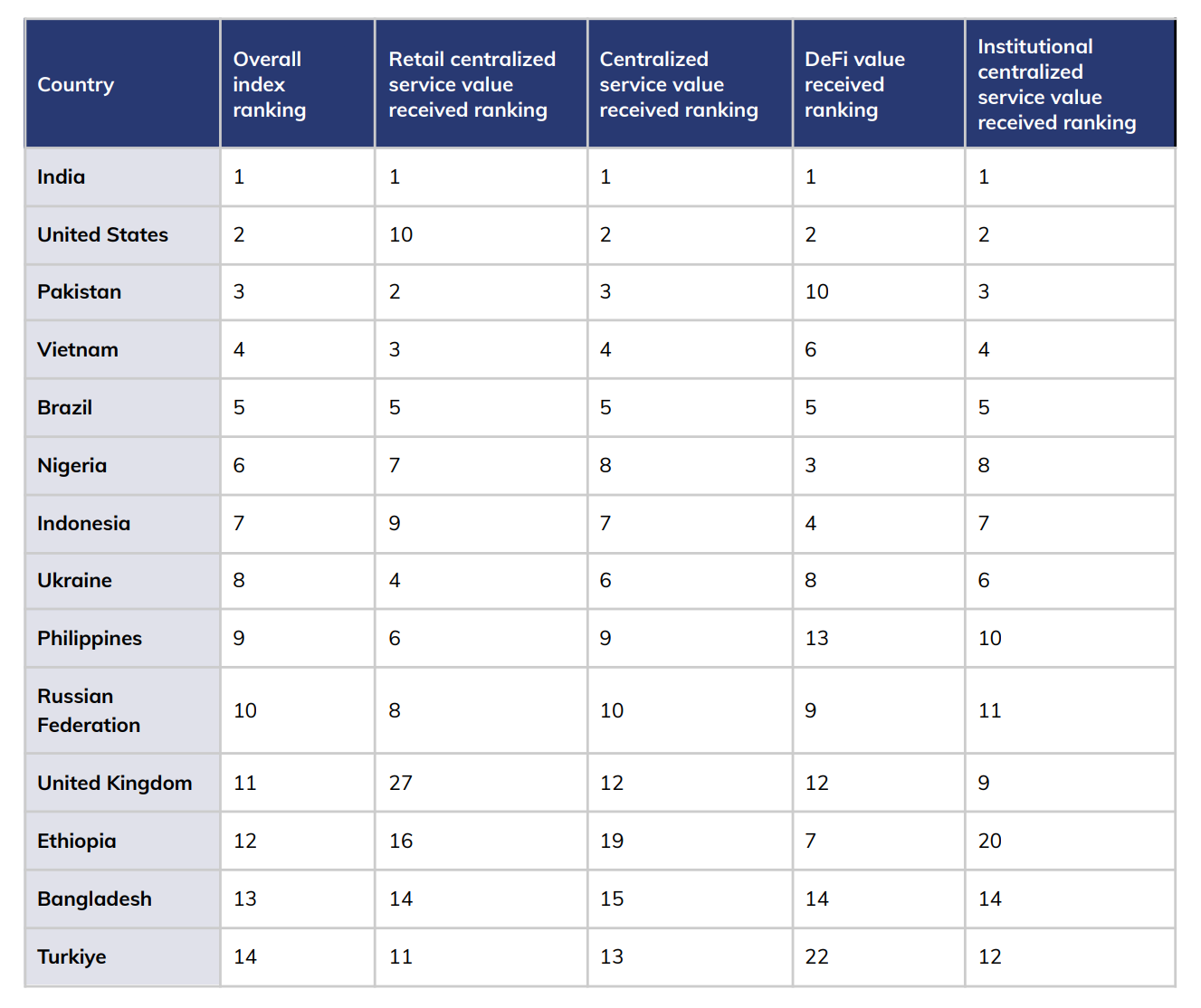
The 2025 Global Crypto Adoption Index Top 20 (Chainalysis)
At number one this year across all subindices, India’s crypto market is both fast-growing and highly complex. First, India leads the index with grassroots and institutional strength. Grassroots adoption is evident in everyday life: from young students experimenting with blockchain and coding, to communities using crypto for small-scale income opportunities.
Interestingly, the regional spread of adoption has moved beyond India’s metropolitan cities as well: smaller Tier-2 and Tier-3 cities like Indore and Jaipur are now leading growth. According to the CoinDCX CEO, about 40% of new users come from these kinds of cities, and in one city (Indore), nearly 10% of the population is using crypto platforms.
India is, moreover, also the clear leader in the region in terms of on-chain transaction volume and placement on the 2025 Global Adoption Index. Early signs of real usage in payments, remittances, gaming, loyalty programs, and micro-earn platforms all indicate how the activity is no longer limited to just price speculation. Retail users increasingly experiment with stablecoins for cross-border transfer, small businesses use crypto to access and take advantage of global liquidity, and NFTs are being used for digital identity, ticketing, as well as creator monetization.
We may argue that India’s broader digital economy – its fintech ecosystem, widespread use of UPI payments, and innovations such as eRupi – also provides strong foundations for growth, whilst regulators and law enforcement agencies are collaborating to establish clear frameworks and oversight for crypto. But public involvement doesn’t stop there.
Indeed, several state governments have also begun experimenting with blockchain applications in land registries, supply chain traceability, and public records, which indicates early institutional interest in Web3-based infrastructure.
Overall, India’s crypto ecosystem combines a very large user base, rising adoption outside of major cities, a very youthful investor profile, and increasing use of crypto beyond pure trading.
Regulation and Policy: India’s “Tax-First” Approach
India’s approach to crypto regulation can be seen as cautious and deliberate. While the assets are not recognised as legal tender, and no such comprehensive legislation has yet been enacted to create a full regulatory framework, what IS clear is that India has adopted a very interesting tax-and-compliance regime for virtual digital assets (VDAs).
Since the Union budget of 2022, crypto and other digital assets in India have been defined as “virtual digital assets” under the Income Tax Act. Profits arising from the transfer of these assets are taxed at a flat 30% rate, regardless of the holding period. In addition, a 1% tax deducted at Source (TDS) is imposed on the sale or transfer of such assets above the specified threshold (ClearTax, Ektha Surana).
Moreover, India’s tax framework for virtual digital assets imposes strict limits on deductions to crypto gains. Only the cost of acquisition, that is, the original purchase price, can be deducted when calculating the taxable price. Losses from one VDA cannot be offset against gains from another or applied to other forms of income.
Alongside this, from July 2025, an 18% Goods and Services Tax (GST) has been applied to fees charged by platforms or service providers facilitating crypto trading, staking, or related services. This, in turn, adds an additional layer of tax burden for both market participants and operators, reinforcing India’s tax-first stance on digital assets.
Beyond taxation, it is also important to understand who exactly in the government actually governs this space. India’s crypto environment seems to involve multiple regulators, that are:
- The Reserve Bank of India (RBI) oversees the monetary stability and banking, which leads to it frequently raising systemic risk concerns. They also lead the CBDC project.
- The Ministry of Finance, along with the Central Board of Direct Taxes, frames tax policies for VDAs.
- The Directorate of Enforcement (ED) investigates money laundering or FEMA-related violations involving these exchanges.
- The Financial Intelligence Unit (FIU) requires the exchanges and service providers to register and report any suspicious activity.
Together, these regulators impact users, builders, and service providers.
Ultimately, despite the heavy tax regime, regulatory clarity does remain incomplete. India currently lacks a sector-specific law governing cryptocurrencies, exchanges, or mining. In practice, this means there is no single piece of legislation like “Digital Assets Act” or “Crypto Regulation Bill” that comprehensively defines what digital assets are, how they should be classified, or which regulatory bodies should oversee them. The result is a semi-formal “regulation by taxation/compliance first, legislation later” model.
This has led to the environment being mixed. On one hand, the tax rules do create clarity and enforceability, ensuring that crypto transactions fall within existing fiscal oversight. On the other hand, the absence of full regulatory definitions and frameworks leaves several risks being unaddressed, particularly for operators, startups, and retail investors.
Whilst India does not ban ownership or trading of VDAs, the Reserve Bank of India and other regulators have expressed concerns about systemic risks arising from (unregulated) crypto activity.
"Crypto currencies cannot be called currencies as they don't have any underlying value," P Vasudevan, an executive director at the RBI, said during a panel discussion organised by IIM-Kozhikode.
An important development that is running parallel to this is the RBI’s active piloting and promotion of the Digital Rupee (e₹), India’s own Central Bank Digital Currency (CBDC), which is a digital form of sovereign currency designated to be a regulated alternative to private VDAs. According to Reuters, the e₹ pilot now processes over one million daily transactions in a single day, driven largely by bank-led initiatives, though activity later cooled as testing progressed.
Developer Ecosystem and Web3 Communities
India is increasingly becoming a powerhouse for Web3 builders and communities. According to a recent Tiger research special report, the country boasts roughly 9.75 million software developers, giving it one of the world’s largest technical talent pools. While just a fraction of these are Web3-native, the country already hosts over 1,200 Web3 projects and has attracted about US $3 billion in ecosystem investment to date.
Notably, India also contributed approximately 17% of new global crypto developers as of 2024, making it one of the largest sources of Web3 developer talent worldwide (Forbes, Douglas B. Laney).
Bengaluru, Mumbai, Hyderabad, and Delhi have come up to become emerging hubs for blockchain development, producing startups across DeFi, gaming (GameFi), layer-2 protocols, real-world asset tokenisation, and so forth. In recent years, India has also started hosting several of Asia’s largest hackathons and meetups like ETHIndia, Polygon Connect, Web3Conf India, and, in turn, drawing thousands of young developers.
Large-scale hackathons, maker-spaces, and university initiatives now serve as frontline accelerators for Web3 talent.
For example, in HackIndia 2025, over 29,000 students across 15 cities and 200+ colleges participated in AI and Web3 tracks, underlining India’s scale of grassroots builder engagement. Meanwhile, the Solana Breakout Hackathon saw 231 Indian team submissions alone. Infrastructure, gaming, and DePIN (decentralised physical infrastructure networks) are emerging as key sectors for these builders.
Opportunities and Challenges
India’s crypto and Web3 sector is positioned at a unique dilemma. On the opportunity side, India’s large, young, tech-savvy population, its dominance in global crypto adoption, and a strong developer base provide a favorable environment for the Web3 space to succeed. The potential to leverage this youth, build Web3 infrastructure and startups, and expand financial inclusion through blockchain-based tools is huge.
Another major opportunity lies in strengthening India’s pool of talent. Introducing blockchain and Web3 courses across more universities can help expand the domestic expertise as well as accelerate innovation. At the same time, more than half of Indian Web3 developers said their salaries do not match global labels, which also may be the result of a bear market and intense worldwide competition for high-quality technical roles. However, as the ecosystem matures and more developers gain seniority, coupled with talent, compensation trends may shift.
Regulatory ambiguity and a heavy tax burden remain a major hurdle. While trading and investing are legal, cryptocurrencies are still not recognised as legal tender, and India lacks the legislative framework and support needed for VDAs to succeed. Security and operational risks further expose the fragilities of this ecosystem. For example, the hack of India’s largest cryptocurrency exchange in 2024, Wazirx, planted seeds of distrust and highlights the need for stronger governance and operational standards.
At the same time, infrastructure and awareness gaps, particularly outside the major cities, likely continue to limit broader participation and create a sort of uneven access. To that end, India can also consider establishing dedicated Special Economic Zones (SEZs) to provide regulatory clarity, tax incentives, and ‘sandbox’ environments for experimentation.
Yet, this is where the real challenge lies: striking the right balance. Over-regulation risks stifling the innovation that has powered India’s Web3 rise, while too little clarity discourages investment and undermines user trust. India may not need entirely new legislation for every technological shift, but it does need a regulatory environment that safeguards users without slowing the pace of experimentation. Achieving that balance will shape how far the country can lead in the next era of digital innovation.
The research and data used in this article are up-to-date as of December 2025.
Read more GM From research pieces:
GM from Kyrgyzstan–Thrilld Labs
GM from Kazakhstan–Thrilld Labs
Resources used
Crypto Adoption Statistics 2025 – Users, Investment & Trends - CryptoGo
Blockchain: The India Strategy
Biggest Indian crypto exchange WazirX hacked, $230 million funds stolen - Times of India
Breakout Bharat: Inside India’s Web3 Grit at the Solana Hackathon - Medium
The Staffing Economics Of Hackathons And On-Chain Credentials - Forbes
India's digital currency transactions top 1 mln/day in Dec - Reuters
Crypto currencies have no underlying value, says RBI - The Economic Times
Is Crypto Legal in India : Regulations & Compliance for Cross-Border Payments - Lightspark
Is Crypto Legal in India : Regulations & Compliance for Cross-Border Payments - ClearTax
Tier-2 cities like Indore outpacing metros in crypto adoption - The India Times
Gen Z Tops India’s Crypto Investments, finds CoinSwitch Q3 2025 Report - CoinSwitch
