
Social Capital in a Token-Biased Network
How does a Web3 project succeed? Or how does any decentralized platform grow its community? The answer to these questions traditionally circled back to the same thing: the token. At the same time, a fixation on token capital alone much overshadows something that’s less quantifiable but equally important, that is social capital. This paper argues that while token capital is important for projects, companies and communities, social capital is equally important for sustaining and developing these networks, and that they are not alternatives, but rather complements. Read on to find out why.

Introduction
How does a Web3 project succeed? Or how does any decentralized platform grow its community? The answer to these questions traditionally circled back to the same thing: the token. How exactly is it priced? Is there enough liquidity? What’s the value? The financial background of decentralised platforms, ecosystems, and projects, i.e., the token economy, has become the lens through which these platforms’ communities, project viability, and growth have been evaluated. Therefore, from pitch decks to media coverage, token capital is placed at the very front and centre.
The framework is not entirely wrong. Token capital, i.e. the financial resources, incentive mechanisms, and governance rights within a project’s native token are definitely central to how these platforms operate (Kivilo et al., 2026). If successful, it funds development and helps facilitate trustless collaboration. However, at the same time, an overwhelming focus on token capital also significantly overshadows something that’s less quantifiable but equally important, which is the social capital.
Social capital refers to the trust, relationships, shared norms, and networks that connect people within and across communities, which can be the source of benefit for individuals and communities (Tsounis & Xanthopoulou, 2025). But, for some Web3 projects, companies and communities, it tends to be treated more as a short term nice-to-have rather than a long term must-have.
This paper argues that while token capital does play a crucial role for financial incentives and funding in entities and communities, social capital is equally important for sustaining and developing these ecosystems, and that they are not alternatives, but rather complements.
About the author: Mehavarthini Ponsornam is a former business development trainee at Thrilld Labs. This paper was the part of her traineeship. Meha studies at Underwood International College, Yonsei University, double majoring in NanoScience and Engineering and Creative Technology Management.
Role and Importance of Token Capital in Decentralised Platforms
Before assessing why social capital matters, we first need to understand what token capital actually does. In decentralised platforms, token capital refers to the financial value stored and distributed through a project’s native tokens, and it serves three main functions: governance, inncentivation, and funding (Kivilo et al., 2026).
As incentive mechanisms, tokens are designed to drive community participation by rewarding users to promote desirable behaviours, such as providing liquidity, contributing code, or securing the network through staking, and so on. Using tokens as incentives may also help increase the overall value of tokens while helping users align their interests with the project’s goals (Meegle, 2025).
Tokens are, for instance, used in Decentralized Autonomous Organization (DAO) governance; protocols like Uniswap(UNI) and MakerDAO(MKR) have pioneered this model, distributing decision-making power across the community through voting based on token holdings rather than concentrating it.
Token capital also serves as a primary funding mechanism. Token sales, along with DAO treasuries, have become some of the principal means by which decentralised platforms and projects raisd capital. As of 2025, over 13,000 DAOs have been established globally, collectively managing a combined treasury of $24.5 billion and engaging more than 11 million governance token holders (CoinLaw, 2025).
Therefore, token capital inevitably serves important functions and makes decentralised collaboration possible. But financial infrastructure, however built, does not sustain itself for long without a strong community and network. Even the most financially strong Web3 companies and projects struggle to make a lasting impact without a community to sustain them (Messari, 2025).
What is Social Capital?
As a matter of fact, the meaning of social capital has evolved over time. The term “Social Capital” was used by Lyda Judson Hanifan to refer to concepts like friendliness, sympathy, goodwill, and so forth. However, it was Pierre Bourdieu in 1986 who introduced it in a more systemic manner, defining it as the collective resource that is accessible to an individual in a group. James Coleman further expanded on this idea, explaining how social capital plays a role in creating human capital, as community support gives development opportunities to individuals. In 1995, Robert Putnam proposed a collective view wherein social capital is the amount of trust and civic participation in a community from which all members can benefit, irrespective of their individual investments (Tsounis & Xanthopoulou, 2025; Putnam, 1995).
Social capital is basically the connections, opportunities, and resources one is able to access by being a part of a strong network. In the Web3 context, social capital takes on three interconnected forms.
First, bonding capital, which refers to the depth of connections within a community. That is basically how strong the ties are between the members. It can be said that a network has a strong bonding capital depending upon how many members within the community have a deep connection, and therefore, naturally, this type of social capital is often seen with communities that have been created around a specific interest, such as the Ethereum community (Charmverse, 2023; Cryptoelephant, 2022).
Secondly, bridging capital refers to connections across communities and networks, allowing groups to access opportunities and resources beyond their immediate network. We have “structural holes” that act in the middle, connecting networks with different areas of expertise (Cryptoelephant, 2022). A community positioned at these structural holes, that is, the gaps between otherwise disconnected groups, gains a monopoly on the flow of information between those mentioned groups (CharmVerse, 2023). More about this structural feature is discussed in the coming sections.
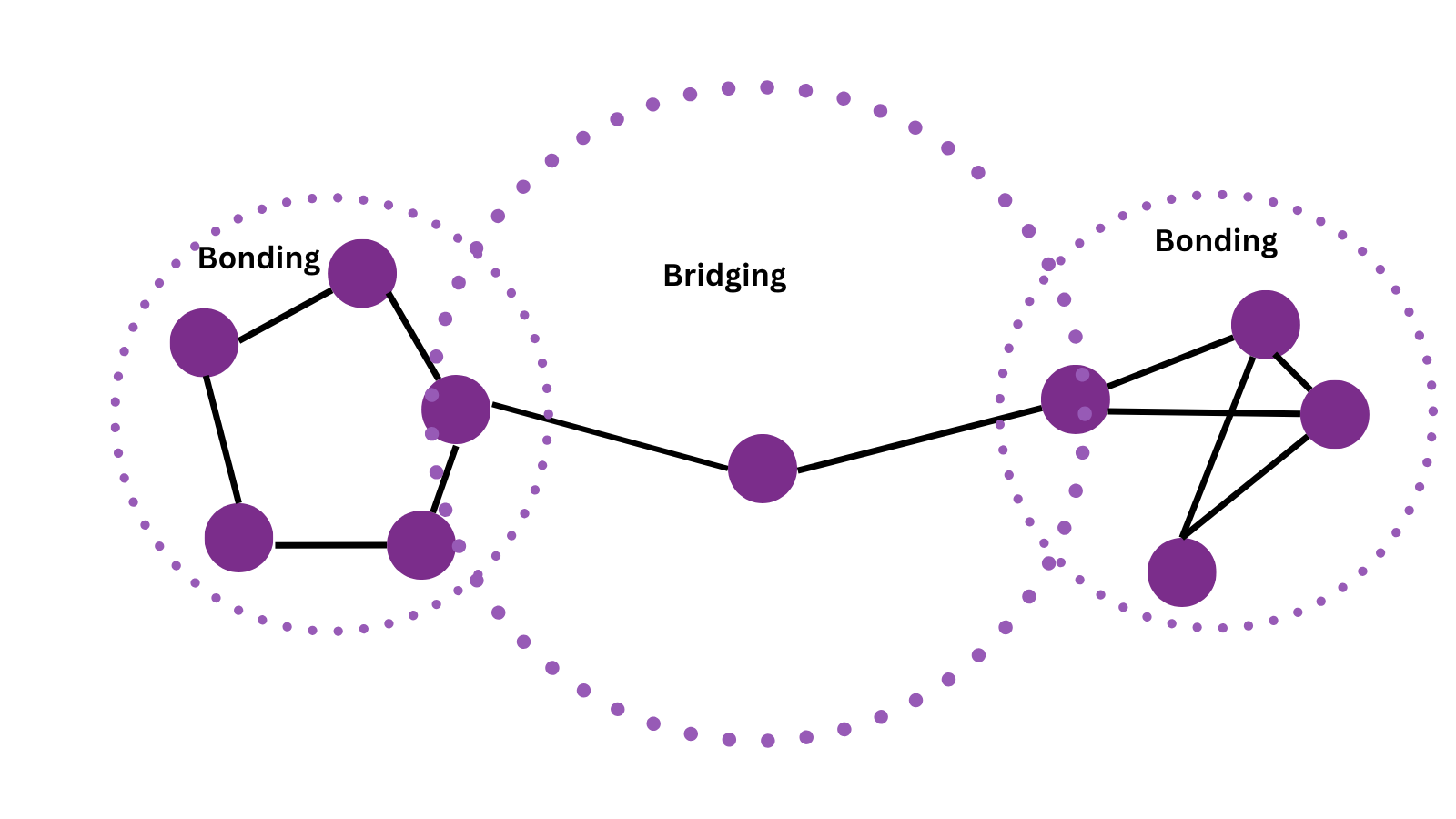
Third, linking capital is a part of bridging capital, with the only variation being that it refers to connecting across different levels of power. While decentralised platforms aim to distribute power broadly, de facto hierarchies do persist, and linking capital captures the essence of those relationships.
There are definitely underlying networking strategies and theories on how to become part of or create a thriving community. Since it is beyond the scope of this paper, we suggest you check out our Networking Theories: Human Connectivity in Web3 article.
Role of Social Capital Alongside Token Capital
Token capital is undeniably effective at drawing participants in. But it is important to think about whether those financial incentives alone are enough to retain said participants and build a community capable of sustaining itself.
Communities built on financial incentives alone are fragile because they are bound to dissolve when prices fall or when a better opportunity arises elsewhere. This is like mercenary capital, in other words, when participants chase after the highest reward and leave at once when another (better) offer comes to the surface (CoinMarketCap, 2024). People in this model keep moving to protocols that give the highest rewards, and they dump the tokens earned quickly for new ones. This may happen during a familiar “doom” loop - token dumps push prices down, incentives become less attractive, more participants exit, and the protocol becomes unstable.
Now, does social capital fix this? The answer is no. Social capital does not immunise a community and underlying project or company against market volatility. One might argue that no community is entirely immune from it, but when people can have actual and genuine relationships within the community and a sense of shared identity, they don’t just disappear when the numbers look bad; instead, they endure through it. Communities with strong bonding capital are far more likely to withstand the volatility of token prices than those held together purely by rewards.
Strong social capital makes communities smarter, in a sense. Communities with strong social capital will experience a better flow of information, greater sharing of creative ideas, and better strategic positioning when compared to similar organisations. When people actually trust each other and communicate openly, information travels faster, bad ideas get challenged sooner, and good ones get built on more quickly (Charmverse, 2023).
Communities with high bridging capital can operate as brokers between institutions or other communities and gain access to diverse perspectives that produce better outcomes. Then, the value of a decentralised community does not simply grow with the number of participants, but can grow exponentially with the number of subgroups each participant can form, which is essentially what Reed’s Law suggested (Beets, 2024).
The incorporation of financialisation and social capital is what Zora and Pump.fun have been experimenting with. Both platforms have tried to incorporate markets directly into social behaviour by making posts, creators, and content into tradeable assets. Zora’s data shows a rapid growth rate but also a sharp decline, since the daily unique creators increased by over 900% between June and late July 2025, reaching 18,200, and settled at 13,300 by November. This clearly shows the early-stage volatility that comes with such a move (Messari, 2025).
Pump.fun, a token launching platform that sought to expand into broadcasting and creator economies has, despite its massive initial user volume, struggled to develop a sustainable social infrastructure. Traders showed little willingness to buy, hold, or repeatedly trade tokens tied to individual creators (Messari, 2025).
Therefore, it is important to note that just like any other concept, social capital has its own limitations and gaps. It only creates value when activated through real connections, but making those right connections in a decentralised setting can be quite challenging.
Potential Risks and Systemic Issues
After having discussed the good social capital brings, it's equally necessary to know what risks and issues might arise.
Echo Chambers, Homophily, and Tribalism
The same bonding capital that holds a community together, if left unchecked, can turn into a closed bubble. When communities become too internally aligned and uniform in their thinking, they tend to start filtering out disagreements, outside perspectives, and mistaking loud early opinions for proper voting and discussion.
This is called homophily: the tendency to connect with people who are similar to you, and, in fact, research has consistently shown that this produces communities that grow more confident while becoming less accurate in their assessments and judgements (PNAS, 2021; ACM, 2018). We argue that in decentralised communities, it could play out as developing “tribal” identities, for instance, ETH vs. SOL, DeFi vs. NFTs, yours vs. theirs.
Tribalism is just homophily taken to its extreme, where people not only prefer their own community but define their identity against others. The financial stakes in decentralised platforms can make it psychologically difficult to support opposing viewpoints: when people's identities and capital are bound together in the same project, the cost of being wrong feels personal, and dissenting perspectives get filtered out rather than engaged with. The financial stakes or the sunk cost one's invested in becoming part of a group can make it psychologically difficult to accept opposing views, hence disagreeing opinions are never taken into consideration.
Reputation Gatekeeping
As much as social capital is centered around relationships and trust and not money, in practice, it concentrates just as much as token capital does, and often in the same hands itself. Looking at DAO participation, for example, data shows that users who earn points and engage early don't always represent the community; rather, they often represent the most “financially privileged”, such as investors or stakeholders with significant token share, leaving behind a more aligned but less diverse participant base (Crypto.news, 2025).
On the other hand, gatekeeping happens at multiple levels just as well. Informally, a small group of well-connected people shape governance conversations before they ever reach a public vote; that is, proposals get pre-lobbied in private Telegram groups and Discord calls, so by the time something hits the main community, the outcome is already largely decided. Informal cliques of people sway community sentiment through their higher reputation, even without commanding large token positions (DAOstar, 2025).
Studies show that as few as 1–5% of token holders effectively control governance in leading DAOs and social capital dynamics can amplify this concentration, rather than correcting it (Springer, 2025). The layer in between - the Discord servers, the Twitter/X spaces, the conference hallways - is doing as much governance work as the on-chain voting mechanisms, but it is far less transparent.
Sybil Attacks
Sybil attacks are instances in which one person creates multiple fake identities to get disproportionate financial resources or governance influence; this is a direct attack on the social capital layer of decentralised ecosystems (Cube Exchange, 2025; Wikipedia, 2025).
Sybil attacks are a major threat, as LayerZero flagged approximately 800,000 wallet addresses as potential Sybil actors during its 2024 airdrop (Digitap, 2025). Bots claimed 40% of another major recent airdrop. Smaller DAOs have had governance proposals passed by single actors who accumulated voting power across dozens of wallets (Humanity.org, 2025). While liquidity mining has become an incentive to attract mercenary capital, social capital and community governance have become ones to attract sybil attacks (Colony.io, 2024).
The thing is that the damage caused by Sybil attacks is not just financial, but it takes away the trust that makes decentralised coordination happen.
Structural Inequality
Where you are positioned in a network, which events you can attend, which communities you have access to, and who you already know determine what opportunities you can reach, and thus, social capital is not uniformly accessible.
This creates structural inequality, at least in opportunity. Path dependency is created, too; the well-connected get more connected through preferential attachment, while those on the sides stay on the sides. Research on social capital in digital networks confirms that, that is, how often one essentially sits between other people's connections is one of the strongest indicators of accumulated social capital and opportunity access (MDPI, 2021).
Conclusion
This isn’t really a debate between token capital and social capital. The honest conclusion is that Web3 and most projects, companies and communities need both. Treating social capital as secondary or as a metric to work on after tokenomics are figured out is not going to help the entity at hand sustain in the longer run.
Token capital is undoubtedly very important. It provides the financial foundation for trustless coordination. But this financial infrastructure does not sustain itself without people building relationships on that foundation.
The evidence throughout this article points consistently in this direction. Communities with genuine social infrastructure with real relationships, shared norms, reputational stakes, meaningful networks hold together – even when token prices fall – make better collective decisions, and distribute opportunity more fairly than those running on financial incentives alone (DAOstar, 2025; Springer, 2025). And platforms like Zora, even in their early stages, are arguably showing that incorporating social depth into financial models may produce more sustainable results than financialisation alone (Messari, 2025).
The systemic risks explored in this article - echo chambers and tribalism, reputation gatekeeping, sybil attacks, and structural inequality - are loopholes that require as much attention as any token mechanism (DAOstar, 2025; Springer, 2025; Formo, 2025).
Thus, rather than questioning whether token capital or social capital matters more, the more productive question is how to invest in both while confronting the structural risks of each. At the same time, by no means are these two forms of capital enough to let a company, project or community succeed. This paper is therefore not meant to provide an exhaustive discussion of all factors that determine success of failure or a mix thereof.
About the author: Mehavarthini Ponsornam is a former business development trainee at Thrilld Labs. This paper was the part of her traineeship. Meha studies at Underwood International College, Yonsei University, double majoring in NanoScience and Engineering and Creative Technology Management.
References
- Tsounis, A. & Xanthopoulou, D. (2025). Social Capital Theory: A Review. In S. Papagiannidis (Ed.), TheoryHub Book. Newcastle University Open Learning. https://open.ncl.ac.uk/theory-library/social-capital-theory.pdf
- Putnam, R. D. (1995). Bowling Alone: America's Declining Social Capital. Journal of Democracy, 6(1), 65–78. https://doi.org/10.1353/jod.1995.0002
- Bourdieu, P. (1986). The Forms of Capital. In J. Richardson (Ed.), Handbook of Theory and Research for the Sociology of Education (pp. 241–258). Greenwood Press.
- Cinelli, M., De Francisci Morales, G., Galeazzi, A., Quattrociocchi, W., & Starnini, M. (2021). The echo chamber effect on social media. Proceedings of the National Academy of Sciences, 118(9), e2023301118. https://doi.org/10.1073/pnas.2023301118
- Garimella, K., De Francisci Morales, G., Gionis, A., & Mathioudakis, M. (2018). Political Discourse on Social Media: Echo Chambers, Gatekeepers, and the Price of Bipartisanship. Proceedings of the 2018 World Wide Web Conference. https://doi.org/10.1145/3178876.3186139
- ACM Digital Library. (2025). Decentralized Web3 Non-Fungible Token Community for Societal Prosperity? A Social Capital Perspective. https://doi.org/10.1145/3710956
- Karoui, M. & Dudézert, A. (2021). Social Capital on Social Networking Sites: A Social Network Perspective. Sustainability, 13(9), 5147. https://doi.org/10.3390/su13095147
- DAOstar / Biedermann & Kozlova. (2025). Social Dynamics of DAOs: Power, Onboarding, and Inclusivity. arXiv. https://arxiv.org/abs/2509.06163
- Springer Nature. (2025). Bridging Social Capital and Financial Incentives: Navigating Liability and Regulatory Challenges in DAO Governance. https://doi.org/10.1007/978-3-032-03273-7_6
- Messari. (2025). The Crypto Theses 2026. Messari Research. https://messari.io/report/the-crypto-theses-2026
- Meegle. (2025). Token Participation Incentives https://www.meegle.com/en_us/topics/tokenomics/token-participation-incentives
- Soocial. (2025). 12 Insightful DAO Statistics to Keep Tabs On. https://www.soocial.com/dao-statistics/
- CharmVerse. (2023). What is Social Capital for Token Communities? https://charmverse.io/post/social-capital-token-communities/
- Crypto Elephant. (2022, December 5). How Social Capital is Evolving in Web3? Coinmonks / Medium. https://medium.com/coinmonks/how-social-capital-is-evolving-in-web3-4dc33411abdc
- Thrilld Labs. (2025). Networking Theories: Human Connectivity in Web3. Thrilld Labs Docs. https://docs.thrilld.io/community-initiatives/thrilld-articles/networking-theories-human-connectivity-in-web3
- Beets, J. (2024, May 20). The Significance of Communities & Social Capital in Blockchain. Balancer Protocol / Medium. https://medium.com/balancer-protocol/the-significance-of-communities-social-capital-in-blockchain-c733d269a290
- CoinMarketCap. (2024). Mercenary Capital. CoinMarketCap Academy Glossary. https://coinmarketcap.com/academy/glossary/mercenary-capital
- Changeengine. (2025). What is Echo Chamber Risk? https://www.changeengine.com/glossary/what-is-echo-chamber-risk
- Crypto.news. (2025, December 15). Web3 Has a Gatekeeping Problem. https://crypto.news/web3-has-a-gatekeeping-problem-opinion/
- Cube Exchange. (2025). What is Sybil Resistance? https://www.cube.exchange/what-is/sybil-resistance
- Wikipedia. (2025). Sybil Attack. Wikimedia Foundation. https://en.wikipedia.org/wiki/Sybil_attack
- Digitap. (2025, December 16). Proof-of-Personhood: How It's Solving Sybil Attacks in 2025 & Beyond. https://digitap.app/news/guide/proof-of-personhood-solving-sybil-attacks
- Humanity.org. (2025). What Are Sybil Attacks — and Could They Ruin Web3? https://www.humanity.org/blog/what-are-sybil-attacks-and-could-they-ruin-web3
- Colony.io. (2024). Demystifying Sybil Attacks in DAOs and Web3. https://blog.colony.io/what-is-a-sybil-attack/
- Formo. (2025). Sybil Attacks in Crypto & DeFi: Risks, Examples, and How to Prevent Them. https://formo.so/blog/what-are-sybil-attacks-in-crypto-and-how-to-prevent-them
- Kivilo, S., Norta, A., Hattingh, M., Avanzo, S., & Pennella, L. (2026). Designing a Token Economy: Incentives, Governance, and Tokenomics. Blockchain: Research and Applications. Elsevier. https://www.researchgate.net/publication/390271393_Designing_a_Token_Economy_Incentives_Governance_and_Tokenomics
- CoinLaw. (2025). Decentralized Autonomous Organizations Statistics 2025: Market Growth, Governance, and Industry Adoption. CoinLaw. https://coinlaw.io/decentralized-autonomous-organizations-statistics/
