
How Has Web3 Fundraising Changed in 2026?
The Web3 fundraising landscape has changed pretty dramatically over the past year or two. Capital hasn’t entirely disappeared, but where and how it is being deployed most definitely has. Dollars continue to flow into the industry, but the market has shifted towards fewer, but significantly larger investment rounds, stronger institutional participation, and a laser focus on execution over hype. Not to forget about relationships. And AI. Click here to find our research and takeaways from our talk with several investors, execs, and fundraising professionals.
Fundraising in Web3 has shifted pretty much over the past year. While venture capital does continue to flow into the industry, most folks know the market is becoming more and more selective. Meanwhile, investors are writing fewer checks, but much larger ones, concentrating capital into later-stage companies with proven traction and clearer paths to long-term growth.
At the same time, stablecoins, tokenisation, digital asset infrastructure, and AI continue to attract institutional attention while traditional financial institutions have are also become active participants in the crypto industry. For founders, this essentially means that fundraising today simply looks very different from the partially hype-driven environment of previous market cycles.
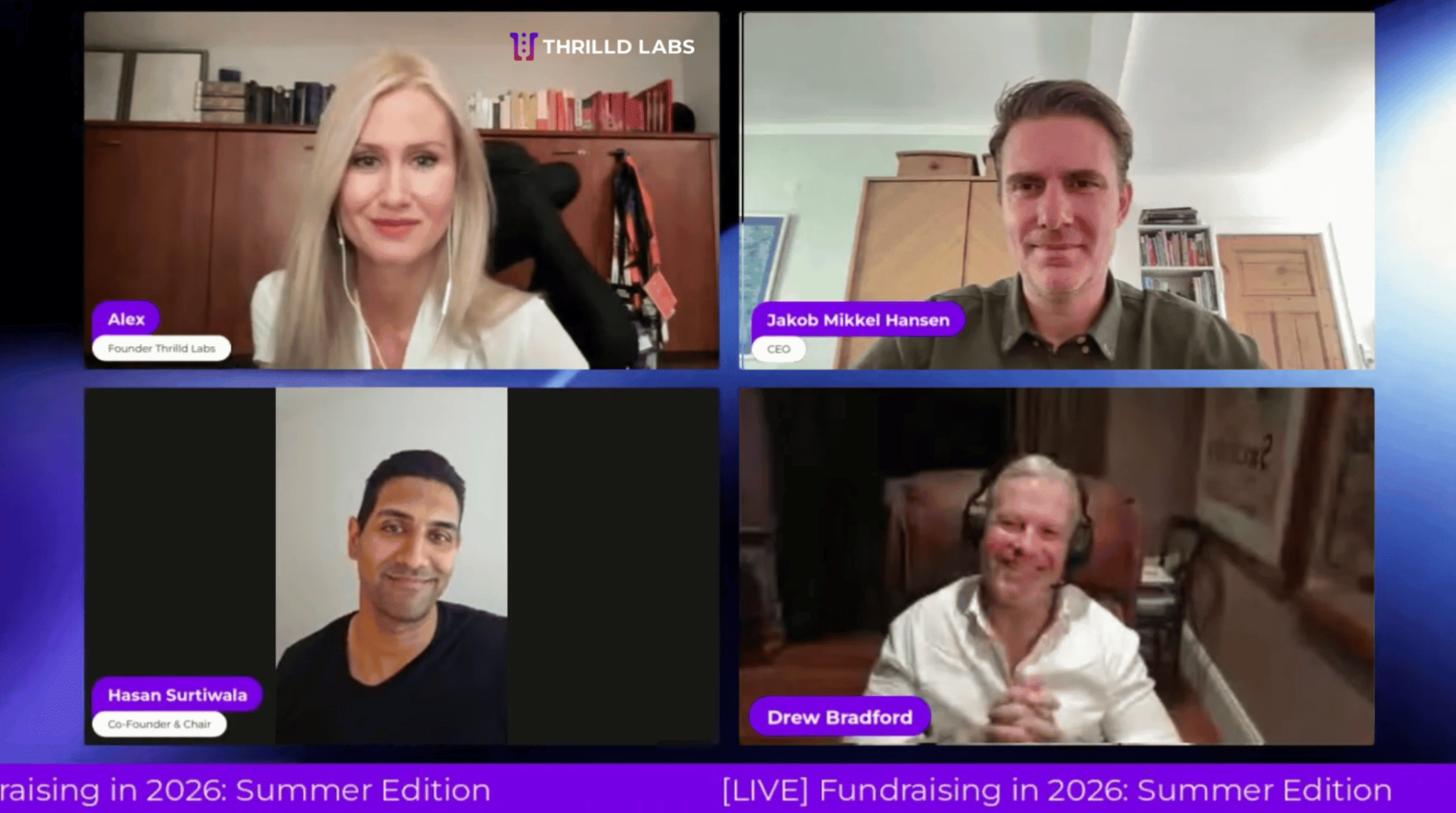
During Thrilld Labs’ latest Fundraising in 2026: Summer Edition, we spoke with experienced investors and professionals in the space discussing what fundraising really looks like in today’s market. The speakers shared practical advice on building investor relations, demonstrating traction, using AI, and how to stand out.
The event was hosted by Thrilld Labs’ founder and CEO Alexandra Overgaag, and featured the CEO of the Nordic Blockchain Association and MP of Ation Invest Jakob Mikkel Hansen, Executive Chairman of Penning Hasan Surtiwala, and founder of Macropod, Drew Bradford. All three speakers brought their perspectives from venture capital, fundraising, and the broader investment space.
In this article, we combine the panel’s insights with the latest market research to see how Web3 fundraising has evolved and what founders can do to raise capital in 2026.
Fewer deals, bigger rounds
One of the most observable themes throughout 2026 is that capital hasn’t necessarily disappeared; it has simply become more concentrated. According to Galaxy Research, crypto and blockchain companies raised roughly $4 billion across 355 funding rounds during Q1 2026. While this represents a significant slowdown when compared to the exceptionally strong final quarter of 2025 (by roughly 50%), fundraising activity still remains above most quarterly funding levels recorded throughout 2023 and 2024.
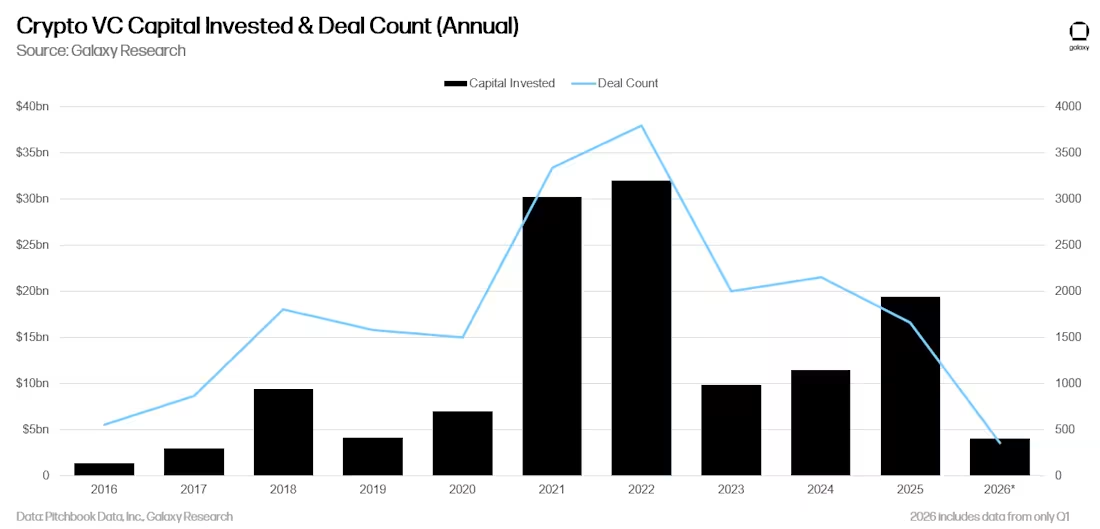
Then, this begs the question: where is the capital flowing? Approximately 57% of disclosed investment went to later-stage companies, highlighting investors’ growing preference for businesses with established traction over early-stage concepts. This trend becomes even clearer when looking at the broader fundraising market. Between March 2025 and March 2026, total crypto funding increased by almost 50% year over year despite the number of active investors declining, suggesting that investors are indeed becoming increasingly selective and concentrating capital into fewer companies and fewer relationships. Rather than chasing speculative opportunities, today’s investors appear to be behaving more like traditional private equity firms, prioritising long-term business fundamentals over short-term narratives.
Institutional capital <> crypto
Another telling trend is the increasing institutionalisation of digital assets. Stablecoins, tokenisation, payment infrastructure, and digital asset services continue attracting significant investment as banks and traditional financial institutions accelerate their adoption of blockchain-related tech and the underlying assets.
In Q1 2026, payments accounted for the single largest category of disclosed crypto investment, followed by prediction markets and financial services. Real-world assets (RWAs), tokenisation infrastructure, and blockchain infra more broadly also remained active investment areas, reinforcing the industry’s shift towards practical financial applications rather than, some might argue, some speculative tokens of prior cycles. This broader movement might suggest something much more telling. That is, the long-standing ideological and practical divide between traditional finance and crypto is narrowing institutions increasingly view blockchain infrastructure as part of mainstream financial markets rather than an alternative to them.
AI remains important, but as an inherent part of the stack
Artificial intelligence attracts enormous amounts of venture capital across the global startup ecosystem. Globally, venture funding reached approximately $300 billion during Q1 2026, with AI companies accounting for roughly $242 billion of that total. Mega-rounds involving companies such as OpenAI, Anthropic, xAI, and Waymo represented nearly two-thirds of all global venture investment during the quarter, which by definition means that Web3 startups are competing not only with other crypto companies but also with AI startups for investor attention.
Yet one important observation from both industry data and our speakers is that investors are more educated today when evaluating AI-focused startups. They look at AI from a systemic perspective. As Hasan Surtiwala explained during the panel, AI should be viewed as part of a company’s growth stack, and not the entire investment thesis. Similarly, Jakob Mikkel Hansen added that investors care far more about the problem a company solves rather than whether AI is involved. In other words, AI should be integrated into a company's operations, enabling execution, improving scalability, and strengthening the product, rather than acting as simply the pitch headline itself.
Always be raising
One idea pushed unanimously by the speakers was that fundraising is no longer something founders switch on once they decide to raise a round. Instead, founders should consistently communicate what they are building, why it matters, and how their company is progressing with potential/targeted investors. Visibility creates familiarity, and familiarity often creates opportunities.
Jakob Mikkel Hansen encouraged founders to think of fundraising as an extension of the company building itself. Every conversation with customers, partners, industry peers, and investors contributes to future fundraising opportunities. Thus, rather than only reaching out once capital becomes necessary, successful founders oftentimes build relationships for months, or even years, before opening a funding round.
Traction is the new deck
If there is one theme that comes back over and over in a selective market, it is traction. According to Drew Bradford, investors increasingly expect measurable evidence that a business is working before committing capital. Founders are expected to clearly explain who they are building for, why customers need the product, what growth they have already demonstrated, and how additional capital will accelerate that growth.
Product-market fit, user growth, partnerships, recurring revenue, transaction volume, and consistent month-over-month (not year-over-year!) progress that prevail over ambitious ideas alone. In sum, execution has become today’s strongest fundraising asset.
But what about vision? While metrics are important, numbers alone rarely secure investment. As Drew explained, founders are ultimately storytellers.
Investors also still need to understand the problem being solved, why it matters, what differentiates the company, and how the business plans to scale over time. Storytelling should continue long after the initial pitch deck. Regular updates and personalised investor relationships are what contributes to building confidence, again, well before a fundraising round officially begins.
Quality over quantity
The panel also touched upon one of the most common fundraising mistakes: contacting every investor possible. Hasan argued that broad outreach campaigns rarely produce any meaningful result and instead founders should identify investors who genuinely fit their company’s stage, sector, and long-term vision. Warm introductions, referrals, and long-term relationship building remain more effective than mass cold outreach.
Jakob also noted that understanding an investor’s portfolio, investment thesis, and geographic focus allows founders to create far more relevant conversations than generic fundraising emails. In today’s market, quality relationships consistently outperform quantity.
Once in talks with someone, building trust via transparency is arguably key. With investors increasingly deploying AI-assisted due diligence and data analysis, exaggerating metrics or overstating traction has become considerably riskier and does no good. Instead, founders should present verifiable data, communicate honestly about challenges, and maintain consistent updates throughout the fundraising process.
For P2P interactions, the ethos was always trust, but verify. With AI, verifiable trust has become a competitive edge.
Conclusion
The fundraising market of 2026 looks very different from the speculative environment many founders became familiar with during previous crypto cycles. The numbers tell us that much.
Capital remains available, but it is increasingly concentrated in companies that with strong execution, traction, and sustainable business models. Investors are becoming more selective, institutional participation continues to grow, and verticals such as stablecoins, tokenisation, digital asset infrastructure, and AI are absorbing the lion's share of capital in our industry. For founders, perhaps the biggest takeaway is that fundraising in the Web3 industry (or what's left of it) is no longer about showcasing hype but rather is about building real businesses, developing relations, and consistently proving that execution actually matches the ambition portrayed.
And, as our speakers noted, fundraising is not a separate process. It’s simply an integral part of building a great company.
***
About the panellists
Hasan Surtiwala is the Executive Chairman of Penning, a Copenhagen-based digital asset platform operating under Europe’s MiCA regulatory framework. With more than a decade of experience in venture finance, fundraising, investor advisory, and business development, Hasan has worked extensively with founders, investors, and funds across the Web3 ecosystem. He has structured and advised fundraising rounds, supported companies on capital-raising strategies, and built long-term relationships across venture and private capital networks.
Drew Bradford is the CEO of Macropod, Australia’s first licensed stablecoin issuer and the company behind AUDM. He has over 35 years of experience across global finance, trading, regulation, and institutional markets. Drew also held senior leadership positions at National Australia Bank and Deutsche Bank. Throughout his career, he has worked at the intersection of capital markets, financial innovation, and digital assets, giving him a unique perspective on institutional adoption and fundraising within the evolving Web3 ecosystem.
Jakob Mikkel Hansen is the CEO of the Nordic Blockchain Association, where he works to unite and strengthen the Nordic and Baltic blockchain ecosystem through industry collaboration, regulatory dialogue, and community-building. With a background in audit, commercial administration, and law, Jakob has previously served as CFO for several international scale-ups, advised Fortune 100 companies on blockchain strategy, and worked as Partner and Head of Due Diligence & Research at an international blockchain investment fund. His experience spans investing, operations, and strategic advisory across the Web3 industry.
Alexandra Overgaag is the founder and CEO of Thrilld Labs. Her background is in law, political science, and the hospitality sector.
